Most tables are mixed. One player knows the game by heart, another has not played anything heavier than cards in years. The right game lets both of them enjoy the evening. Four questions do most of the work.
1. How many chairs, really
Start with the number of people who will sit down, not the number printed on the box. Many games technically stretch to six but play best at four. On the club's shelf each game shows its player range, and the shelf can be filtered by player count. A table at the club goes ahead once it reaches the game's minimum, so a game with a low minimum is a safer choice when you are not sure how many will join.
Some examples from the shelf:
- Two players: 7 Wonders Duel (about 30 minutes) or Hive Pocket (about 20).
- Four to six: King of New York (2 to 6 players, about 40 minutes).
- A larger group: Feed the Kraken (5 to 11 players) or 6 nimmt! (2 to 10).
2. How long is the evening
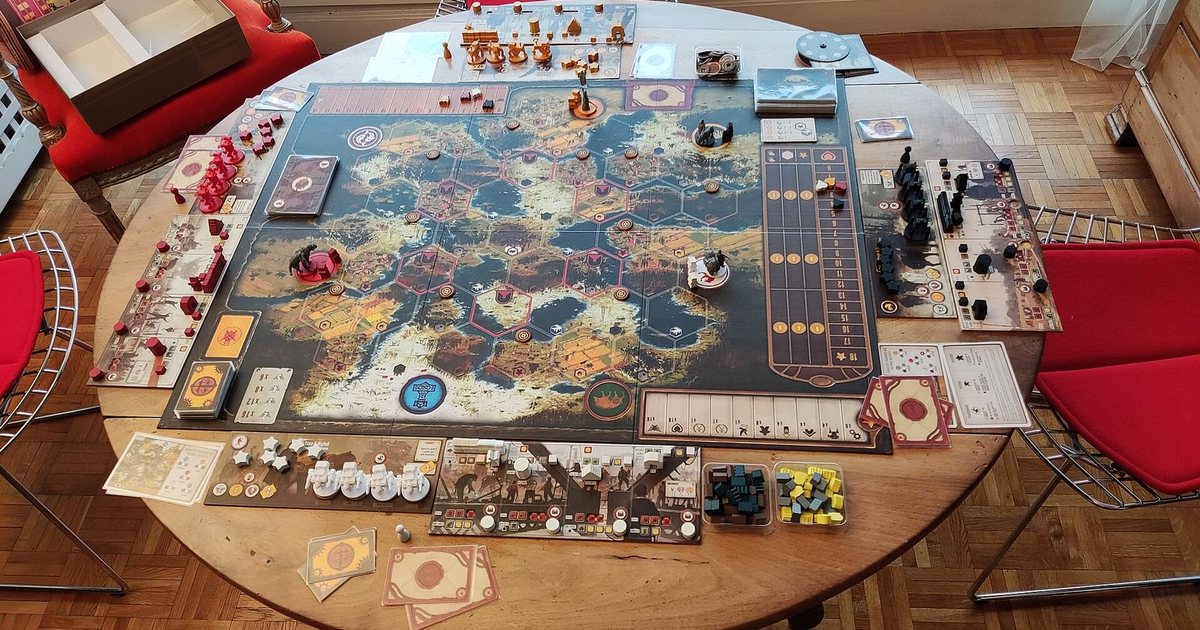
An evening has a start and a firm close. Count back from the close, leave time for the rules, and choose a game that fits with room to spare. A long strategy game such as Scythe, at around two hours, wants a table that commits to it. War Room runs to a full day and waits for a group that wants one. A quick game such as Exploding Kittens, at about 15 minutes, can open or close an evening around something bigger.
3. How much teaching it needs
The club sorts its games by what they ask of the players:
- Quick. Short rules and sharp interaction, easy to restart when someone arrives late. Unstable Unicorns, Here to Slay, BANG!.
- Taught. Games that need someone at the table who knows the rules. King of New York, Command of Nature, Feed the Kraken.
- Big games. Large productions and heavy strategy, opened ahead for a group that commits. Scythe, Scarface 1920, Senjutsu.
For a mixed table, a taught game is often the sweet spot: enough depth for the experienced player, and a teacher for everyone else. When you open a table at the club, marking it New to it tells people the rules will be taught from the start.
4. How the players interact
Some groups enjoy direct conflict, others prefer to build something quietly side by side. A game with a lot of attacking and stealing can sour a table of strangers, while a calm puzzle such as Cascadia suits almost anyone. Co-operative games such as Pandemic put the whole table on one side, which takes the sting out of a first game. Hidden-role games such as BANG! and Feed the Kraken reward talk and bluffing and work best when the table is in the mood for it.
A short checklist
- The player count fits comfortably, not at the edge of the box.
- The game, with teaching, ends well before the evening closes.
- Someone at the table can teach it, or the table is marked New to it.
- The kind of interaction suits a table that may not know each other.
Browse the shelf with these in mind. Each game page has a short account of how it plays and who it suits.